

Start with the shared moment
Before you write, think of one real detail that connects you to the person. It could be a tradition you share, a recent catch-up, their favourite festive treat, an inside joke or the fact that they're celebrating away from home. Even something simple, such as "I hope you get your usual first plate of gujiya," can feel more personal than a paragraph about the meaning of Holi.
Keep the line focused on the relationship rather than on a generic description of the festival. Ask yourself, "What would I say if I were handing them this card in person?" You might say, "I wish we could do our usual Diwali sweet-tasting round this year," or "Thinking of you while you celebrate far from home." That natural spoken feeling is exactly what a ready-made card needs.
Use a simple personal-line formula
A reliable way to personalise a festival greeting card is to use three parts: greeting, personal detail and warm wish. Start with the festival and their name, add one detail that shows why you thought of them, then end with a kind wish. This keeps the message warm without making the card feel crowded.
Try this template: "Happy [festival], [name]! I always think of [specific memory/detail] at this time of year. Wishing you and your family a beautiful celebration." For a card, caption or status share, use the shorter version: "Happy [festival], [name], hope your day is full of [specific thing] and good company." You can swap "beautiful" for "peaceful", "joyful", "fun" or "restful" to suit the recipient.
Examples for different relationships
For a friend, let the line sound like something you'd say during a chat. "Happy Holi, Riya! Hope your day is as colourful and chaotic as our college celebrations, minus the 8 a.m. start." The memory does the personal work, while the small joke makes it sound like you, not a greeting-card company.
For a relative, mention a family habit, favourite dish or conversation you miss: "Eid Mubarak, Maasi! Missing your biryani and our long after-lunch conversations. Wishing you a peaceful, happy Eid." A relative may appreciate affection more than cleverness, so don't worry about making the wording polished.
For a colleague, keep it friendly and considerate without sounding overly familiar. "Happy Diwali, Arjun! Thank you for making busy days lighter. Wishing you a bright break and plenty of sweets." You can also write, "Wishing you a joyful celebration and a well-earned rest after all those deadlines."
For a neighbour, a warm local detail works beautifully: "Happy Pongal, Meena aunty! Wishing your home a joyful celebration, and saving space for one more serving of sakkarai pongal." If you don't know the person well, mention the shared building, street or community instead of guessing at family details.
Make it sound like you
Use words you'd actually say out loud. If "May this auspicious occasion illuminate your life with endless prosperity" isn't part of your everyday vocabulary, you don't have to use it. A brief "Miss you", "Wish you were here" or "Looking forward to seeing you soon" can feel much warmer than a grand sentence.
Add the recipient's name or a familiar sign-off, especially when you're sending a ready-made image that could otherwise look forwarded. "Love, Neha", "With hugs, Appa" or simply "See you soon. Rahul" may be all the extra personality the card needs. Humour is welcome when it suits the relationship, but keep jokes away from sensitive moments and formal contacts.
Adapt the line to the festival
Your personal line can include a festival-specific wish without assuming everyone celebrates in exactly the same way. Depending on the person, you might wish them light, peace, new beginnings, togetherness, good food or a proper break. For example: "Hope Christmas brings you a quiet morning, good coffee and time with the people you love," or "Wishing you a Holi full of colour, laughter and no ruined phone screens."
For a mixed group or colleague, choose inclusive wording such as "Wishing you a joyful celebration" or "Hope this festive season brings you peace and happiness." Don't turn the personal line into a religious explanation, a lesson or a list of blessings the recipient may not relate to. The card is there to connect, not to explain someone else's celebration back to them.
If you're planning ahead, check the date before sending. Diwali falls on Sunday, 8 November 2026, while Holi falls on Monday, 22 March 2027, with the supplied calendars noting that some dates may shift by a day. A quick check can save you from sending a beautifully personalised card on the wrong morning.
Keep the message short on every format
For WhatsApp, place the personal line above or below the card image so it's visible without opening a long message. One or two sentences are enough: "Happy Eid, Sana! Thinking of your famous dessert table today, hope your celebration is full of family, laughter and second helpings." The image can carry the main greeting; your line simply shows why you chose to send it.
For Instagram, use a concise caption or add the line to the image only if it remains easy to read. Tiny text placed over the main greeting usually makes the card harder to enjoy. A caption such as "Happy Diwali to the friend who makes every gathering brighter. Miss you!" keeps the post personal without covering the design.
For a printed card, write one specific sentence by hand and add your name. Your handwriting doesn't need to look perfect. "Can't wait for our annual Christmas movie marathon, have a lovely day!" often feels more thoughtful than a carefully designed paragraph copied from somewhere else.
Check before you send
Take a quick pause before pressing send. Confirm the recipient's name, the festival, the spelling and their preferred form of address, especially when you're sending to a workplace contact or a group. "Happy Pongal, Meena" and "Happy Pongal, Meena aunty" can carry different levels of familiarity, so use the one that feels natural to them.
Avoid forwarding the same personal line to everyone. For close recipients, change at least the detail, opening or sign-off so the message doesn't feel mass-produced. You can keep the same card and structure while writing "Thinking of your new home" to one person and "Missing our late-night chats" to another.
Send at a considerate time, too. Festivals can involve travel, guests, prayer, work or a pleasantly full phone battery queue. You don't need an immediate reply to know the message landed well. If you're sending a card from FreeWishes, the festival calendar and wish writer can help with timing and first-draft wording, but the final personal detail should come from you.
A small line is enough
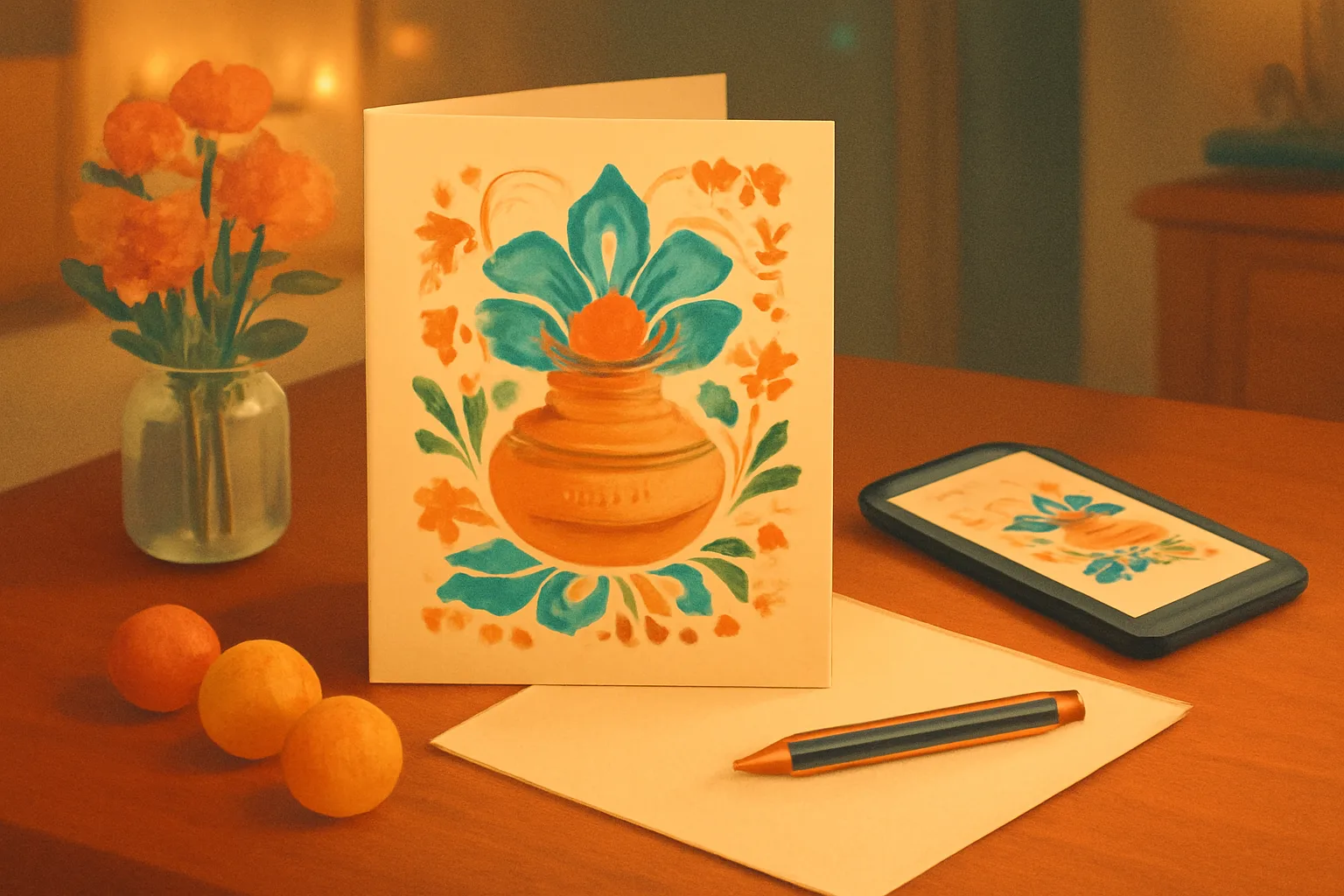
The card can do the visual work. Your added line only needs to show why this person came to mind. A memory, a favourite food, a shared plan or a simple "I miss you" is enough to turn a ready-made design into something that feels chosen for them.
Use this final fill-in template when you're stuck: "Happy [festival], [name]! Thinking of you because of [shared detail]. Hope you have a [warm/special/peaceful] celebration." Fill in the brackets honestly, keep the sentence sounding like you and send it before you've had time to overthink it.