

The sentence that changed its meaning
Article 1 of the Universal Declaration of Human Rights begins with a sentence that is now familiar across borders: "All human beings are born free and equal in dignity and rights." It continues by saying that people are endowed with reason and conscience and should act towards one another in a spirit of brotherhood. ([un.org](https://www.un.org/en/about-us/universal-declaration-of-human-rights/?utm_source=openai))
The phrase "human beings" does more than sound modern. It makes the declaration explicitly inclusive. Had the text retained "all men," readers could have treated the word as a supposed stand-in for everyone, but women and girls would still have been linguistically placed in the background. Hansa Mehta's intervention helped connect the promise of equality to the people it was meant to protect.
Who was Hansa Mehta?
Hansa Jivraj Mehta was an Indian freedom activist, educator, writer, social reformer and politician. She served in India's Constituent Assembly, became president of the All India Women's Conference, and represented India in international forums including the United Nations Commission on Human Rights. She later served as vice-chancellor of SNDT Women's University and the Maharaja Sayajirao University of Baroda. ([msubaroda.ac.in](https://msubaroda.ac.in/Smt-Hansa-Mehta?utm_source=openai))
Education was not a side note in her life. Mehta argued for women's education and worked to build institutions that gave women access to learning, professional preparation and public participation. The Maharaja Sayajirao University of Baroda records her role in creating and strengthening faculties including Home Science, Fine Arts and Social Work. That wider work matters because it keeps her from being reduced to one famous sentence in one international document. ([msubaroda.ac.in](https://msubaroda.ac.in/Smt-Hansa-Mehta?utm_source=openai))
The room where the wording was debated
The Universal Declaration was not written by one person in one sitting. From 1946 to 1948, delegates worked through drafts in the UN Commission on Human Rights, its drafting committee, the Economic and Social Council, the General Assembly's Third Committee and finally the General Assembly. Eleanor Roosevelt chaired the Commission during the drafting process, while Mehta was one of the delegates shaping the text. ([research.un.org](https://research.un.org/en/undhr?utm_source=openai))
That process brought together representatives from different countries, legal traditions and political systems. They debated not only the meaning of rights, but also how a declaration should relate to national law and international enforcement. The UN's archival records show Mehta taking part in working groups and presenting proposals about liberty, equality, education, security and participation in government. ([research.un.org](https://research.un.org/en/undhr/chr/1?utm_source=openai))
Mehta's intervention
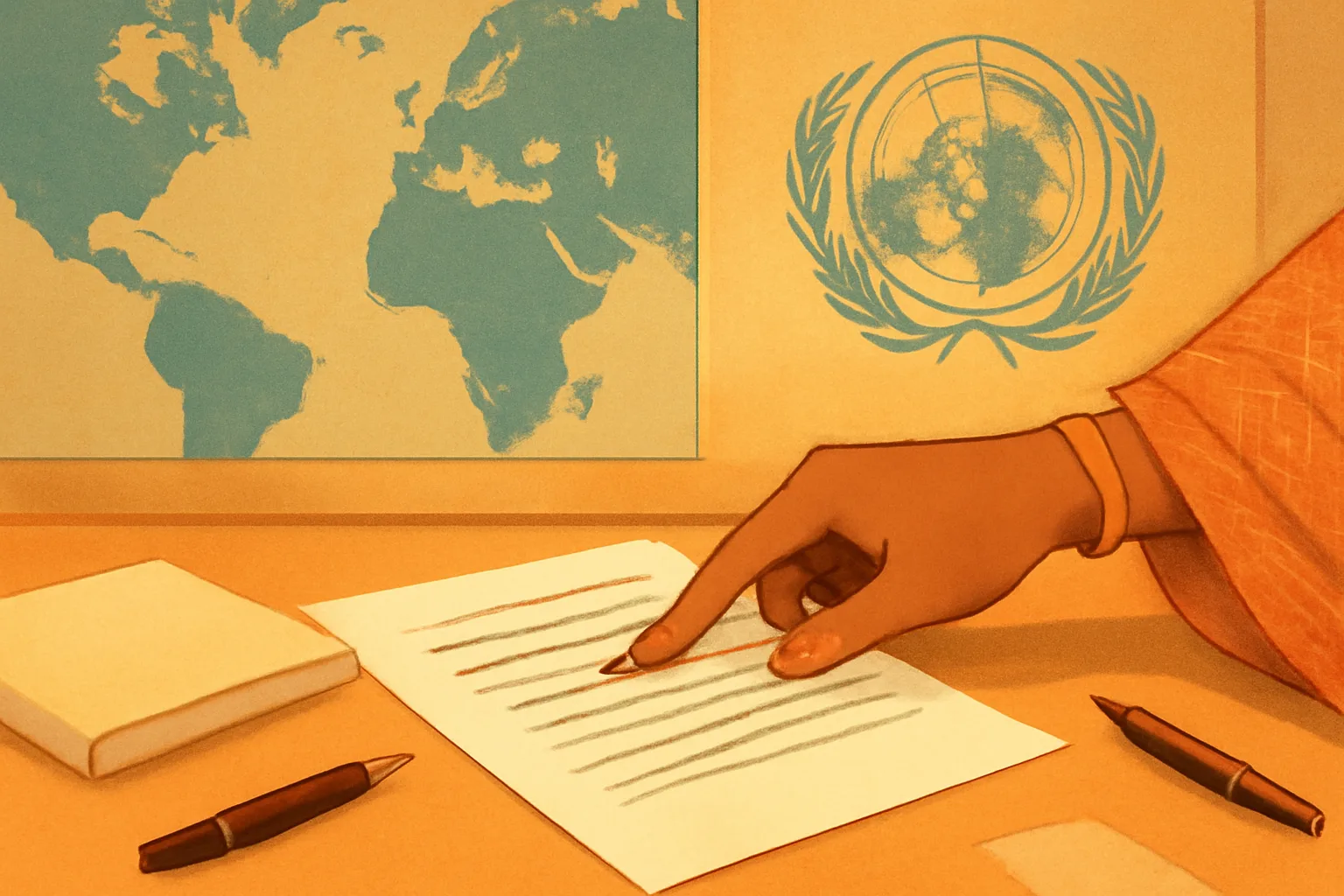
The commonly documented account is straightforward: Mehta objected to the draft wording "all men are born free and equal" and argued for "all human beings." The wording that appeared in the final Article 1 was "All human beings are born free and equal in dignity and rights." The United Nations describes Mehta as widely credited with making this change. ([un.org](https://www.un.org/en/about-us/universal-declaration-of-human-rights?trk=public_post_comment-text&utm_source=openai))
The careful version of the story matters. Mehta was a crucial advocate for gender-inclusive language and helped secure an important change, but she did not write the entire Universal Declaration by herself. The document emerged from years of negotiation, with major contributions from Eleanor Roosevelt, Charles Malik, Peng-chun Chang, René Cassin, John Humphrey and many others. Mehta's achievement was not solitary authorship; it was the insistence that a universal promise must use words that visibly include women. ([un.org](https://www.un.org/en/about-us/udhr/history-of-the-declaration?utm_source=openai))
Why one word mattered globally
A declaration about equal dignity cannot sound as if one sex represents the whole human race while the other is merely assumed. "Human beings" gives the principle a clearer foundation: equality belongs to every person because every person is human. That may look like a small linguistic decision, but language can influence who is imagined as a citizen, a rights-holder, a decision-maker and a full participant in public life.
The UDHR is a declaration, not a directly enforceable global law. Still, the United Nations describes it as a milestone and a common standard of achievement, and says it inspired later human-rights treaties and equality movements. Mehta's wording alone did not create women's rights worldwide. It was one important contribution within a much larger international effort to make dignity, freedom and non-discrimination part of public life. ([un.org](https://www.un.org/en/about-us/universal-declaration-of-human-rights/?utm_source=openai))
The wider Indian context
Mehta's work at the United Nations grew from a longer record of advocacy in India. In the Constituent Assembly, she spoke about women's equality of status and opportunity, arguing that political freedom would mean little if women continued to face inequality through law, custom and social practice. She was one of only 15 women in the Assembly, where she also took part in the public life of a country building its constitutional institutions. ([constitutionofindia.net](https://www.constitutionofindia.net/debates/19-dec-1946/?utm_source=openai))
India's contribution to the UDHR was broader than Mehta's role. Indian delegate Lakshmi Menon argued for non-discrimination based on sex and for the equal rights of men and women, while Indian constitutional debates supplied a living context for discussions about equality, citizenship and fundamental rights. Mehta's international work reflected a practical belief: equality should appear in institutions, education and law, not only in speeches. ([mea.gov.in](https://www.mea.gov.in/Images/amb/India_United_Nations_new1022.pdf?utm_source=openai))
A lesson you can share
Hansa Mehta reminds us that equality is not only a grand ideal; sometimes it begins by asking who is included in one ordinary sentence. When a school rule, office policy, family message or public announcement uses broad language, it is worth checking whether the words actually include the people affected by them.
Here's a concise version to share: "Hansa Mehta helped change 'all men are born free and equal' to 'all human beings are born free and equal' in the UDHR. Her lesson: inclusive words can protect inclusive ideas." For an editor's fact-check, attribute the wording change to Mehta's advocacy, cite the official Article 1 text, and avoid saying she single-handedly authored the declaration. ([un.org](https://www.un.org/en/about-us/universal-declaration-of-human-rights/?utm_source=openai))
A sentence still worth choosing
The sentence Hansa Mehta helped shape has lasted because it does something every good message should do: it makes its audience visible. "All human beings" leaves less room for convenient assumptions and more room for the equal dignity the declaration promises.
That is a useful test for our own words, too. Before sending a message, writing a rule or making a decision, pause and ask: "Before I send this, who might feel left out, and can I choose better words?"