

The practical problem Kurien encountered
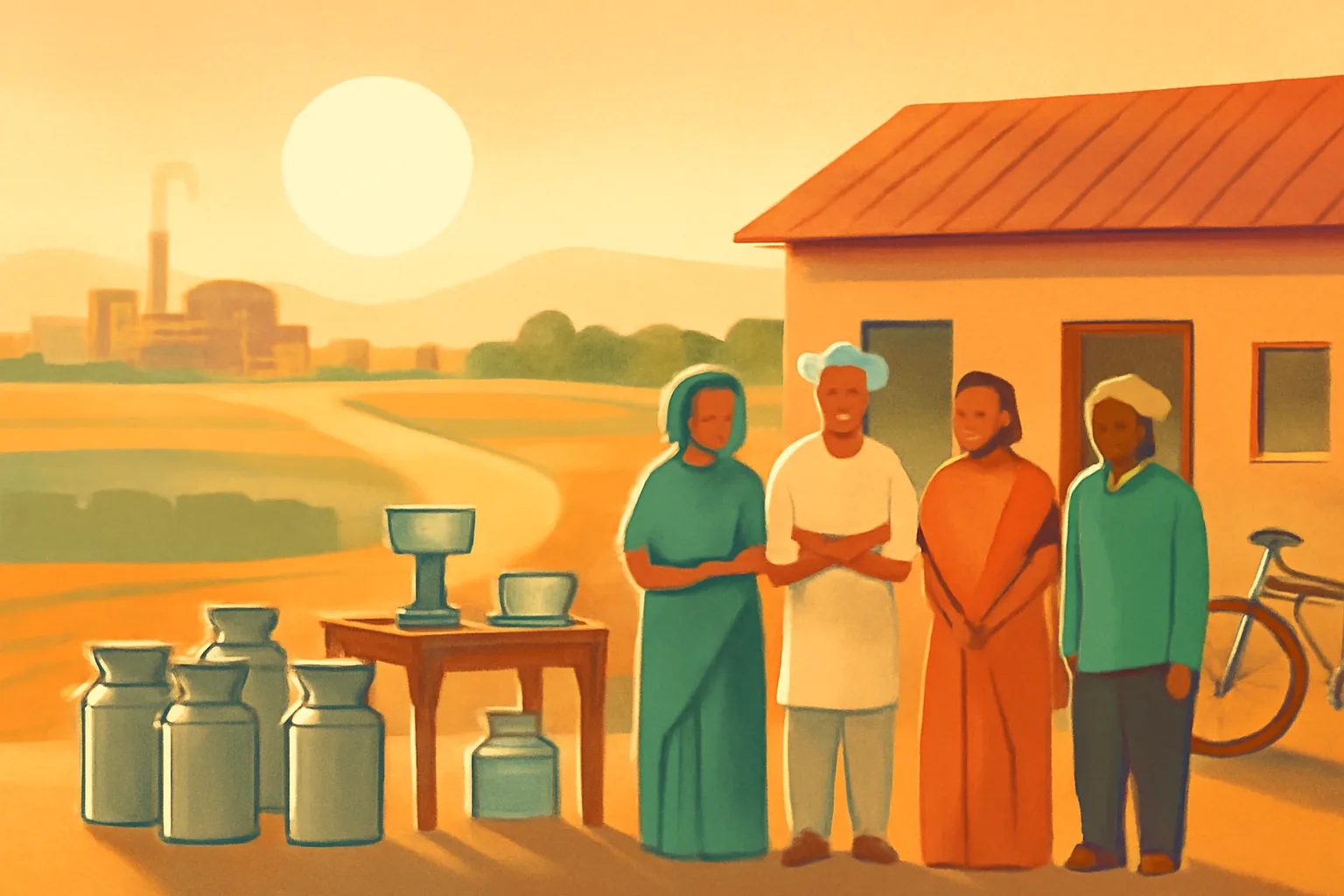
Before the milk revolution, India had plenty of milk producers, but the path from village animal shed to city kitchen was uncertain. Collection was fragmented, pricing was often controlled by contractors, and processing and distribution were not organised around the interests of small producers. In Kaira district, the Bombay Milk Scheme bought milk through Polson, while contractors remained powerful in the villages and farmers had little say over what they were paid. ([nddb.coop](https://nddb.coop/farmer/dairying/movement))
That makes this more than the story of one gifted manager. The real work was organising thousands of producers around ownership, dependable procurement and professional processing. What changes when the people supplying a product also own the system that buys and sells it? They gain a stronger voice, but they also need functioning institutions, reliable records, quality checks, roads, cooling facilities and people who know how to run a complex operation. Kurien’s autobiography, I Too Had a Dream, presents that institutional struggle alongside the NDDB’s account of dairy development. ([mbibooks.com](https://www.mbibooks.com/product/i-too-had-a-dream/?utm_source=openai))
Who was Verghese Kurien?
Verghese Kurien was born on 26 November 1921 in Calicut, now Kozhikode, Kerala. He studied physics at Loyola College and later trained as an engineer, eventually earning a master’s degree in mechanical engineering from Michigan State University. After returning to India, he was sent to Anand in 1949 as an officer in the government’s dairy division. His initial plan was not to spend his life there; Anand was meant to be an assignment, not a destination. ([drkurien.com](https://drkurien.com/biography/?utm_source=openai))
The assignment changed because the cooperative movement gave his technical and managerial skills a larger purpose. Kurien later became the founding chairman of the National Dairy Development Board, serving from 1965 to 1998, and helped guide Operation Flood. He died on 9 September 2012 in Nadiad, Gujarat. The dates matter, but the larger point matters more: he was not working alone. His contribution was to build institutions in which producers, elected representatives, technicians and professional managers could do different jobs well. ([nddb.coop](https://www.nddb.coop/about/chairman/vkurien))
Anand and the cooperative idea
The cooperative foundation came before Kurien. Tribhuvandas Patel helped organise the Kaira District Cooperative Milk Producers’ Union, formed in 1946 by milk producers in Kaira district, now Kheda district. The movement began with village-level dairy cooperatives in June 1946, and the union was registered in December that year with five village cooperatives as members. It grew from a farmers’ movement against an arrangement that left producers at the mercy of private traders and contractors. ([nddb.coop](https://nddb.coop/farmer/dairying/movement))
Its structure was simple enough to understand and strong enough to scale. Village dairy cooperatives collected milk from producers. A district union procured and processed that milk, arranged payments and provided services connected with animal productivity. A wider federation could then market milk and dairy products under a common brand. Kurien’s role was to strengthen the technical, managerial and marketing side of this structure while producers retained ownership through the cooperative system. Amul was not created as Kurien’s private company; it grew from the producer movement in Kaira. ([nddb.coop](https://nddb.coop/farmer/dairying/movement))
How Amul made the model visible
Processing was the practical breakthrough. Fresh milk is perishable, and a small producer who must sell it immediately has little room to bargain. Once milk could be collected, tested, chilled and converted into products such as butter, milk powder and other dairy foods, it could travel beyond the local market. Processing did not solve every problem, but it helped connect village production with urban demand instead of leaving each farmer to find a buyer twice a day.
Amul became the public face of the Kaira cooperative movement. The name was coined in 1955 as an acronym for Anand Milk Union Limited, and the brand later became associated with a wide range of dairy products. ([amul.com](https://www.amul.com/files/pdf/6-10-15-Cow-to-consumer.pdf?utm_source=openai)) The model aimed to balance two needs: producers needed a dependable market and payment system, while consumers needed a larger and more organised supply. Its success still depended on administration, infrastructure, participation and market conditions. A familiar brand could open the door, but the cooperative structure had to keep doing the daily work behind it.
Operation Flood: scaling the lesson nationally
Operation Flood was launched in 1970 as a national dairy development programme, with the National Dairy Development Board playing the central implementing role under Kurien’s leadership. Its most memorable idea was the National Milk Grid: connect rural milk producers with major urban markets so that seasonal shortages, regional surpluses and price variations could be managed more effectively. The aim was not simply to produce more milk, but to build a route through which producers could reach consumers on better terms. ([sapplpp.nddb.coop](https://sapplpp.nddb.coop/about/genesis/flood?utm_source=openai))
The programme used dairy commodities provided through international assistance as a way to help finance infrastructure, procurement, processing and marketing. In Phase I, skimmed milk powder and butter oil supplied through the European Economic Community and the World Food Programme were sold to support the programme, rather than treated as a permanent substitute for domestic production. Phase I ran from 1970 to 1980, Phase II from 1981 to 1985 and Phase III from 1985 to 1996. ([sapplpp.nddb.coop](https://sapplpp.nddb.coop/about/genesis/flood?utm_source=openai))
What changed for ordinary producers
The national numbers show a substantial change. NDDB records milk production rising from 21.2 million tonnes in 1968–69 to 31.6 million tonnes in 1980–81, 53.9 million tonnes in 1990–91 and 66.2 million tonnes in 1995–96. By 1998, India had emerged as the world’s leading milk producer. These figures should not be credited to one person alone: they reflect Operation Flood, state-level efforts, animal services, infrastructure and the work of millions of producers. ([nddb.coop](https://www.nddb.coop/sites/default/files/Milk-prod_PCA.pdf?utm_source=openai))
For producers, the practical changes could include a more organised procurement network, access to processing and urban markets, and a stronger institutional voice through membership and elected cooperative bodies. An illustrative example—not a single documented farmer’s story—would be a small producer moving from selling raw milk at a vulnerable local price to supplying a village society that tests, collects and channels the milk into a larger system. The benefits were never identical everywhere. Cooperatives needed local participation, veterinary and breeding services, feed, roads, cooling facilities and capable management to work well. ([nddb.coop](https://nddb.coop/farmer/dairying/movement))
Lessons without turning Kurien into a slogan
The first lesson is to start with the bottleneck. Kurien’s work addressed collection, processing, pricing and distribution, not only production. When a group is told to work harder, the better question may be: where is value being lost before the product reaches the customer? The second lesson is to separate ownership from professional execution. Producers could own the cooperative while trained professionals handled technology, finance, quality and marketing.
The third lesson is to build for scale through linked institutions. Village societies, district unions and marketing federations made local participation compatible with national reach. The fourth is to measure the system, not just the symbol. A serious assessment would look at producer payments, reliability, milk quality, participation, services and consumer access—not simply use the word “revolution” as a motivational label. NDDB itself describes the Anand Pattern through elected farmer governance, professional management, year-round markets and equitable sharing. ([nddb.coop](https://nddb.coop/farmer/dairying/movement))
The system outlives the founder
Kurien’s lasting contribution was not only Amul’s recognisable name. It was an institutional design that gave producers a stake in the value chain and connected that stake to technology, management and markets. The system needed leaders, but it was designed not to depend forever on one leader.
That brings us back to the opening problem. The milk revolution became powerful when ordinary producers were connected to ownership, infrastructure and markets—not merely asked to produce more. The precise takeaway is simple: a durable success story is often a well-designed system in which many people can participate, build bargaining power and share in the value created.