

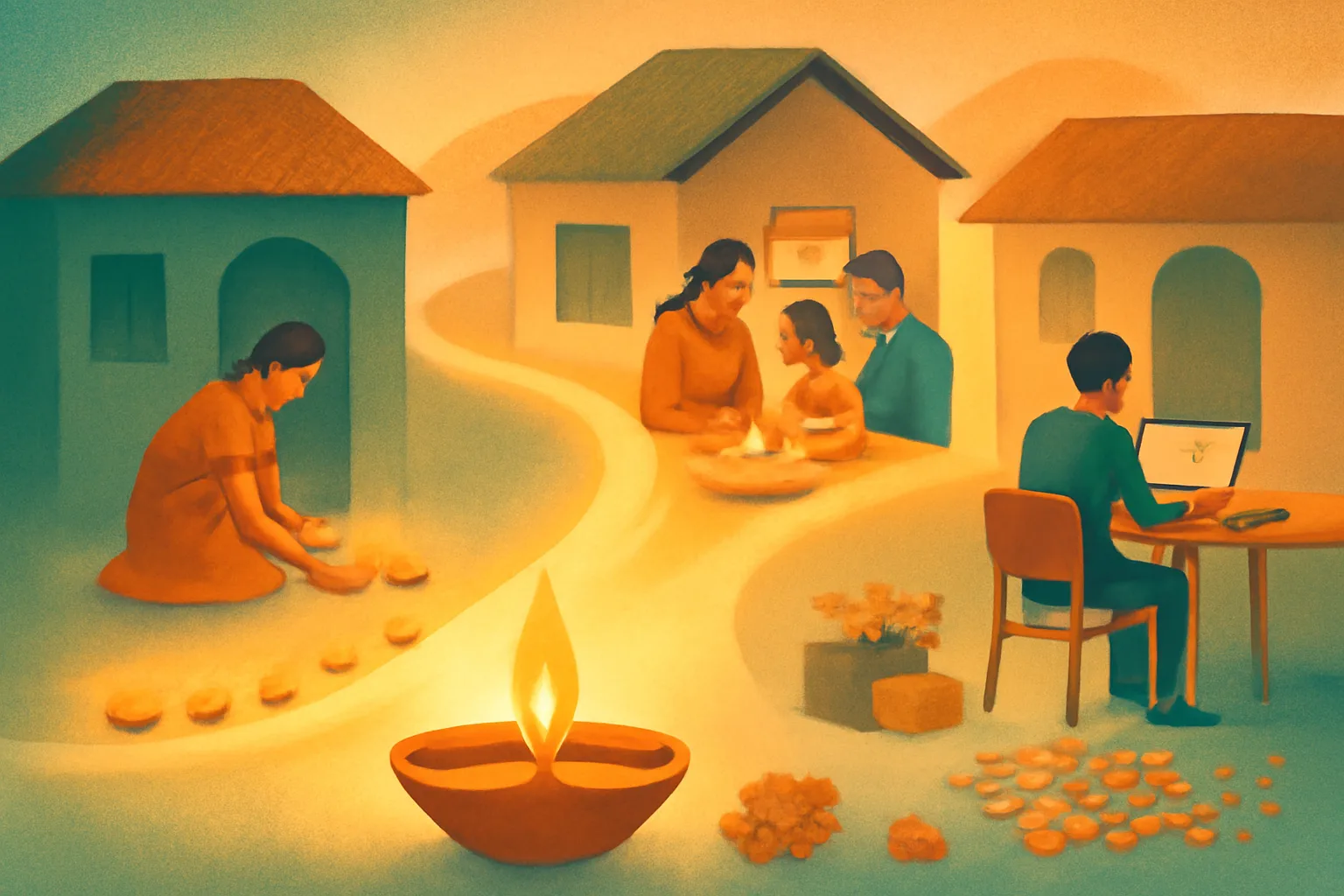
Start With One Shared Diwali Plan
You don’t need to coordinate an entire festival to feel close. Choose one or two moments everyone can realistically join: lighting diyas, saying a family prayer, sharing a meal, playing a quick card game or raising a short toast. For Diwali in 2026, which falls on Sunday, 8 November, a weekend plan may suit some families—but work shifts, children’s routines and time zones still matter.
Ask each household what Diwali means to them this year before making decisions. One family may want a traditional prayer, another may prefer a quiet meal, and someone else may simply want to hear everyone’s voices. Include relatives who aren’t comfortable with video calls by offering a phone call, recorded message or photo exchange.
Keep the plan easy to understand: “Date and time: 8 November, 8 pm India time. Activity: light diyas and share one photo. Who’s bringing what: each home brings its own sweet or snack. Backup plan: send a voice note by bedtime. Shared space: the family chat.” A small plan that happens is better than an ambitious one that leaves everyone stressed.
Create a Shared Ritual Across Distance
Agree on one simple action and do it at the same time. Light diyas, candles or lamps, then send one photo or a short video instead of trying to keep a long call running. The point isn’t to create a perfect split-screen celebration; it’s to mark the same moment in separate homes.
Make the ritual personal to your family. You might say a blessing, read a meaningful line, play a familiar song, share one thing you’re grateful for or remember someone who is missed. Families with different faiths, regions or traditions can choose their own practices while sharing a common moment.
A message sent beforehand can make the plan feel warm rather than logistical: “At 8 pm our time, let’s light a diya together and send a photo. It won’t be the same as being together, but it will be ours.” That honesty matters. Nobody has to pretend that a phone screen is the same as a crowded living room.
Share the Food, Not Just the Menu
Food carries family history, but sharing it across countries doesn’t require identical ingredients. Cook the same dish if time and supplies allow, or choose one easy common item such as chai, pakoras, a sweet or a family recipe that can be adapted locally. Send a quick preparation video showing the important bit: how much spice your mother adds, when your aunt says the mixture is ready or the shape your sibling always gets wrong.
Exchange recipes and ingredient substitutions without declaring one version the “right” one. Diwali food changes from home to home and region to region. Mention allergies, dietary choices and local availability clearly, especially when children or older relatives are eating. A recipe can be shared as a story too: “This is the sweet we made after moving into our first flat. It never looks perfect, but it tastes like that evening.”
A same-day delivery or homemade parcel may work for nearby family, but keep it optional. Customs, postage, delivery schedules and local rules can make sending food, lamps or oils difficult across borders. For a low-pressure virtual tasting, each household can show one dish and explain its story instead of attempting a full meal on camera.
Make Video Calls Feel More Human
A 20- to 30-minute call with one clear activity often works better than an open-ended family meeting. Give it a loose running order: greetings, show the diyas or decorations, share food, include elders and children, take a group screenshot, then say goodbye properly. A little structure prevents the call from becoming ten people talking over one another.
Test links, chargers, speakers and internet access beforehand. If an older relative struggles with video, offer an audio-only call or ask someone nearby to help them join. If a child wanders off or someone has to return to work, don’t treat it as a failed celebration. The call only needs to hold one good moment.
When people are too busy to join, send a personal voice note or video message with one detail from your evening. “I wore the blue kurta you gave me, and the balcony looks lovely with the lights on. I’m missing you tonight. Happy Diwali.” That will feel more thoughtful than a generic greeting sent to every contact.
Bring the Celebration Into Their Home
A small care package, e-gift or local delivery can make distance tangible. Choose something that reflects the person: mithai, snacks, flowers, a book, a craft kit, a handwritten note or something useful after the festival. For someone living abroad, a local delivery may be easier than sending a parcel from India. Plan around postal and delivery cut-offs, and check local rules before sending food, lamps, oils or other items across borders.
For children, include an activity they can do while connected, such as decorating diyas, making a rangoli design, dressing up or creating a family photo collage. You could say, “Send us a photo of your rangoli before dinner—we’ll make one on our side too.” The activity gives a call something to gather around, even when attention spans are short.
For older relatives, prioritise comfort and familiarity. A printed photo, a phone call at their preferred time, familiar sweets or help arranging their home may mean more than a complicated surprise. Ask what would actually make the day nicer instead of assuming a large parcel or long video call is best.
Save the Little Moments Together
Create one shared album or family chat thread for decorations, outfits, food, rangoli, fireworks where permitted and quiet moments at home. Ask each person to send one photo and one line answering a prompt such as “What made this Diwali feel special?” or “What do you wish we could see here?” A prompt helps people share more than a stream of forwarded images.
Later, turn the collection into a simple digital keepsake: a collage, short slideshow or voice-note compilation to enjoy when everyone has more time. Keep it low effort. A handful of real photos—a child holding a crooked diya, a grandparent smiling at a sweet, an empty chair saved for someone away—can tell the story better than a polished production.
Be careful with privacy and safety. Ask before posting family photos publicly, and don’t pressure anyone to appear on camera or share their home. The family chat should feel like a welcome place, not another stage where everyone has to perform festive happiness.
Send Wishes That Admit the Distance
The best Diwali wishes usually contain one detail that could belong only to your relationship. Mention the missed meal, a family tradition, a shared memory or what you hope to do when you meet. Send the message before the busiest part of the day, then follow up with a call or voice note so it feels personal rather than like a forwarded status.
For parents, try: “Happy Diwali, Ma and Papa. I’m missing your mithai, the noisy kitchen and sitting beside you while the diyas are lit. I hope your evening is peaceful and bright. We’ll celebrate properly together when I’m home.” For a sibling, you could write: “Happy Diwali to my favourite nuisance. Save me the good sweets, send photos of the decorations and remember that I’m still winning our card game from this side of the world.”
For someone spending Diwali alone, send: “I know today may feel quieter than you wanted. I’m thinking of you, and I hope you find one gentle, happy moment tonight. Message me when you’re free—we don’t need a big plan.” For a colleague, a respectful note works well: “Wishing you and your family a peaceful and joyful Diwali. May the festival bring warmth, rest and good moments together.”
You can adapt this message when you’re stuck: “This Diwali, I’m missing your ___ most. Even from far away, I’m lighting a diya for our family and sending you love, peace and plenty of reasons to smile.” Add the person’s name and a real detail before sending. The extra minute is what makes it yours.
Let the Missing Be Part of Diwali
Celebrating away can bring homesickness, guilt or family tension. Someone may be working through the festival, caring for a child, travelling or simply not feel cheerful. Nobody has to perform happiness for the camera. It’s all right to say, “I’m glad we’re talking, but I’m also missing home today.” That sentence can make the conversation more honest and less tiring.
If the live plan fails, choose a kind fallback. Exchange voice notes, watch the same film later, eat the saved sweet together on another date or schedule a proper reunion meal. You can also use a shared reminder for the next family gathering so the promise doesn’t disappear after the lights come down.
Being apart doesn’t make the celebration less meaningful. Sometimes the most honest Diwali plan is a small shared gesture: a diya lit at the same hour, a recipe sent across borders, a photo saved in the family album or a promise to meet when you can. The distance is real, but so is the effort to reach across it.