

Name the kind of loneliness you feel
Before trying to fix the day, give yourself two quiet minutes and finish this sentence: “Today feels lonely because I am missing…” You may be missing a particular person, the familiar noise of home, privacy, energy, a sense of belonging or the version of the festival you expected to have. Sometimes the answer is simply, “I don’t know yet.” That counts too.
Then ask what would help most right now: comfort, company, distraction, practical help or space. A person who needs company may ask for a call, while someone overwhelmed by a crowded home may need half an hour alone. Naming the need makes it easier to ask for the right thing instead of hoping somebody guesses.
Your feelings don’t have to be tidy. You can be grateful for a festival and still feel homesick. You can enjoy the lights and want the celebrations to end early. You can love your family and feel lonely among them. Several things can be true in the same room.
Make a small connection plan
Choose one person who feels safe and send a specific message instead of waiting for them to notice. Try: “I’m feeling a little alone today. Could we have a 10-minute call tonight?” A clear request is kinder to both of you than a vague “What are you doing?” that may lead nowhere.
Keep the connection low-pressure. You could exchange voice notes, share a meal over video, walk with a neighbour, attend a local community event or join an online prayer or celebration that feels right for you. You don’t need a large gathering; one warm exchange can change the shape of an evening.
Use a simple three-part plan: who you’ll contact, when you’ll contact them and what you’ll do if they don’t reply. Keep a second option ready, such as calling a cousin, sending a voice note to a friend in another time zone or taking a short walk. One missed call is a missed call, not proof that you’re unwanted.
Ask for the kind of support you actually need
People often want to help but don’t know what to say. Give them an easy way in. You might write, “Please tell me one ordinary thing about your day,” “Can you sit with me while I have tea?” or “I don’t need advice—just company.” Ordinary conversation can feel especially comforting when everyone else is talking about grand celebrations.
If you’re working during the festival, ask a colleague about a small shared break, swap messages with another person on shift or plan a post-work treat. It could be a favourite snack, a late-night film or a quiet call on your way home. Working through a holiday doesn’t make your feelings less valid, and you don’t have to act cheerful for the entire shift.
A crowded home can be lonely too. If noise and constant togetherness are wearing you down, say, “I want to join later, but I need 30 minutes alone first.” You can also suggest a clear time to return. A boundary isn’t a rejection of your family; it’s a way to come back with more patience.
Create a gentler celebration
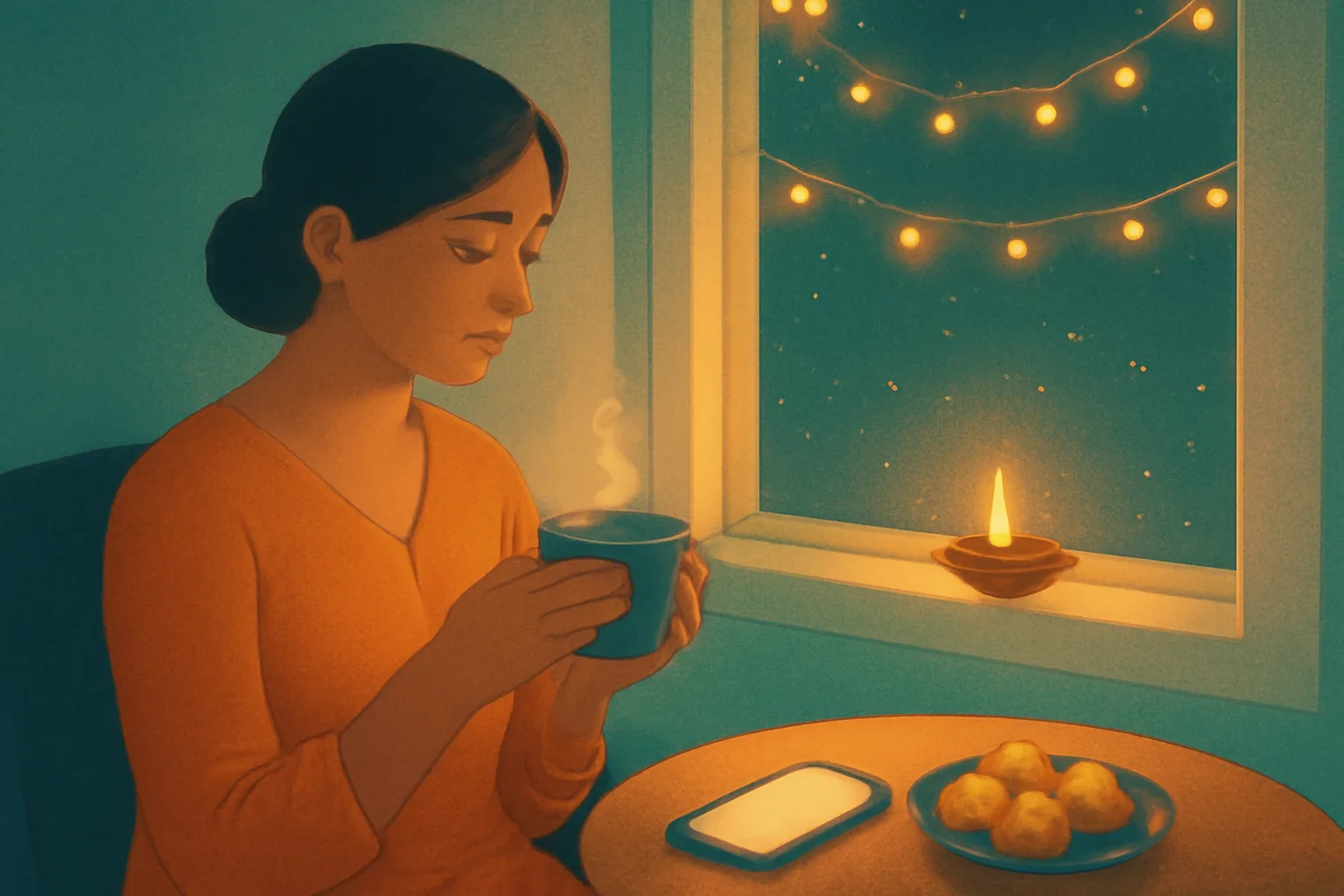
You don’t have to recreate the whole festival to make it meaningful. Pick two or three elements that comfort you: a favourite dish, music, clothes, prayer, decoration, film, sweet or evening walk. For Diwali on Sunday, 8 November 2026, that might mean lighting one diya and calling someone you love instead of organising a full gathering. For Christmas on Friday, 25 December 2026, it might be one familiar song and a warm meal.
Adapt the celebration to the place you’re in. A rented room, hostel, hospital room, work break or quiet home can still hold one meaningful ritual. You might decorate a small corner, wear something festive for yourself or eat the dish you associate with home. The celebration can be modest and still belong to you.
Make a small “today list” with three parts: one thing for your body, one thing that connects you to someone and one thing that brings a little pleasure. That could be a proper meal, a voice note and an episode of a familiar show. Small plans are easier to keep when your energy is low.
Stay connected to someone you miss
If you’re grieving, make room for remembrance without forcing cheerfulness. Light a candle or diya, cook their favourite food, look at one photo or tell someone one story about them. You don’t have to turn the memory into a polished tribute. Sometimes saying, “They would have complained about this loud music,” is a loving way to keep them close.
You can also write a message you cannot send. Begin with: “I wish you were here for ____. Today I remember you by ____.” Write about the food, the family joke, the empty chair or the small detail you noticed. You don’t need to show it to anyone.
Let the ritual stay optional and changeable. You don’t have to celebrate exactly as you did before the loss, and you don’t have to repeat the same remembrance each year. Grief can make familiar days feel different; adapting isn’t forgetting.
Protect yourself from comparison
Social media can turn a tender day into a stream of polished family photos, matching outfits and overflowing plates. Set limits before the loneliness peaks. Check apps at set times, mute accounts for the day or move them off your home screen. You can care about people and still choose not to watch everyone else’s celebration in real time.
A photo shows a moment, not the whole relationship or household. It doesn’t show the argument before the picture, the person missing from the frame or the quiet hour after the guests leave. A quiet festival is not a failed festival, and a small celebration is not a lesser one.
When comparison starts taking over, ask: “What would make the next hour 5% kinder for me?” The answer might be putting your phone down, washing your face, calling home, making tea or changing into comfortable clothes. You don’t have to solve the whole day.
Have a plan for the difficult hours
Write a short backup list before loneliness peaks. Include things you can do without much planning: call someone, take a shower, step outside, order or cook something nourishing, watch a familiar film, visit a safe public place or rest without guilt. Put the list in your notes app or on paper so you don’t have to think of options while upset.
If the feelings become overwhelming, contact a trusted person and say plainly, “I’m not doing well and I need you to stay with me on the phone.” If you may harm yourself, contact local emergency services or a crisis helpline immediately, or go to a place where another safe person is present. You deserve immediate support, not silence.
Don’t measure the whole festival by one difficult hour. A hard morning can be followed by a calmer afternoon. You only need to take the next small step: drink some water, answer one message, sit near a window or make the call you planned.
Let the day be yours, too
After the festival, choose one thing to carry forward. It could be a monthly call, a new local connection, a personal ritual or a clearer boundary around family and work. A difficult holiday can still teach you what kind of support feels genuine and what you want to change next time.
You can celebrate fully, quietly, later or not at all this year. Belonging doesn’t require performing happiness on schedule. If all you manage is a meal, a shower and one honest conversation, that is still care.
Make a small promise to yourself: “I will not abandon myself today. I will give myself food, rest and one honest connection.” You don’t have to feel joyful to deserve gentleness, and you don’t have to face a lonely festival as though it means you are alone in the world.